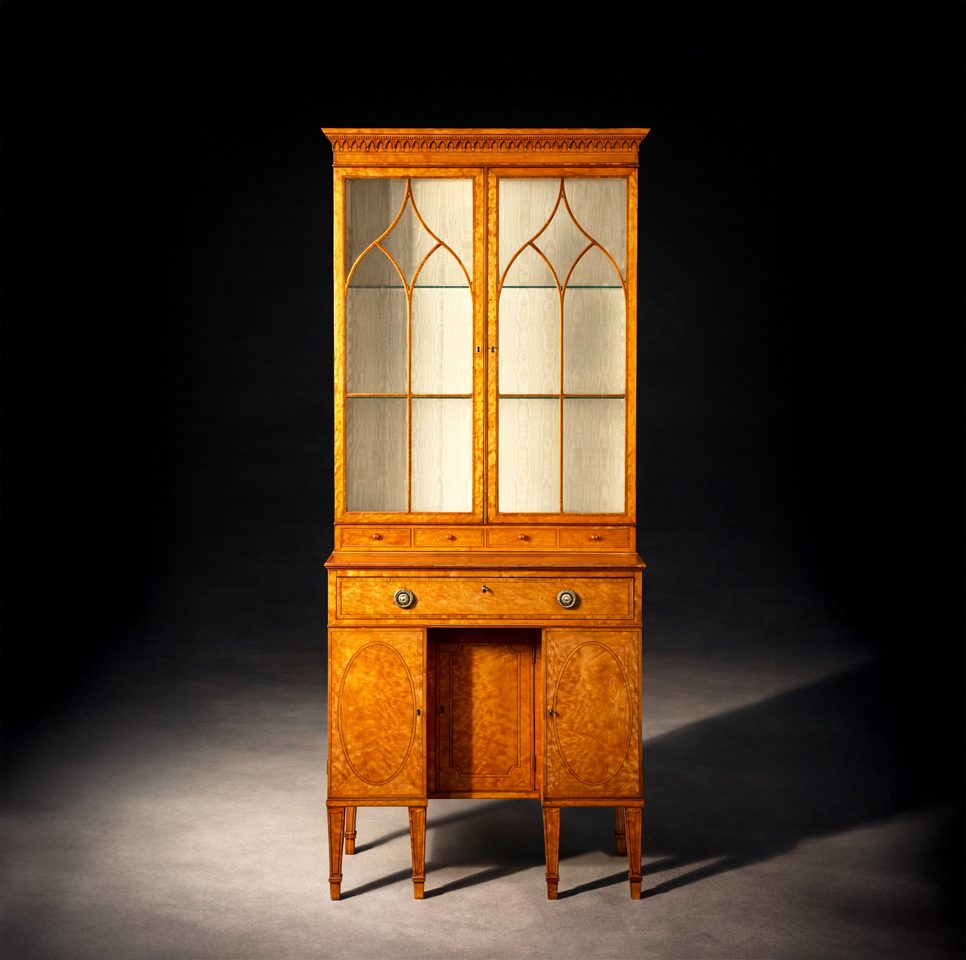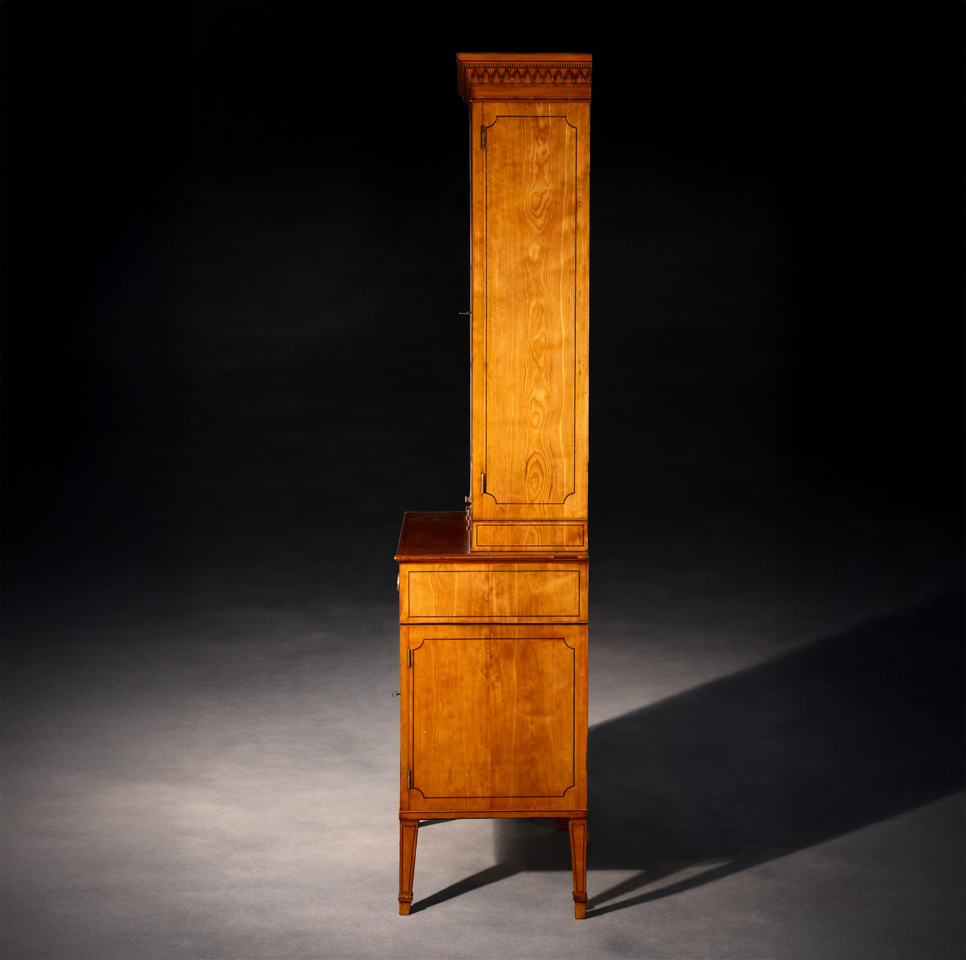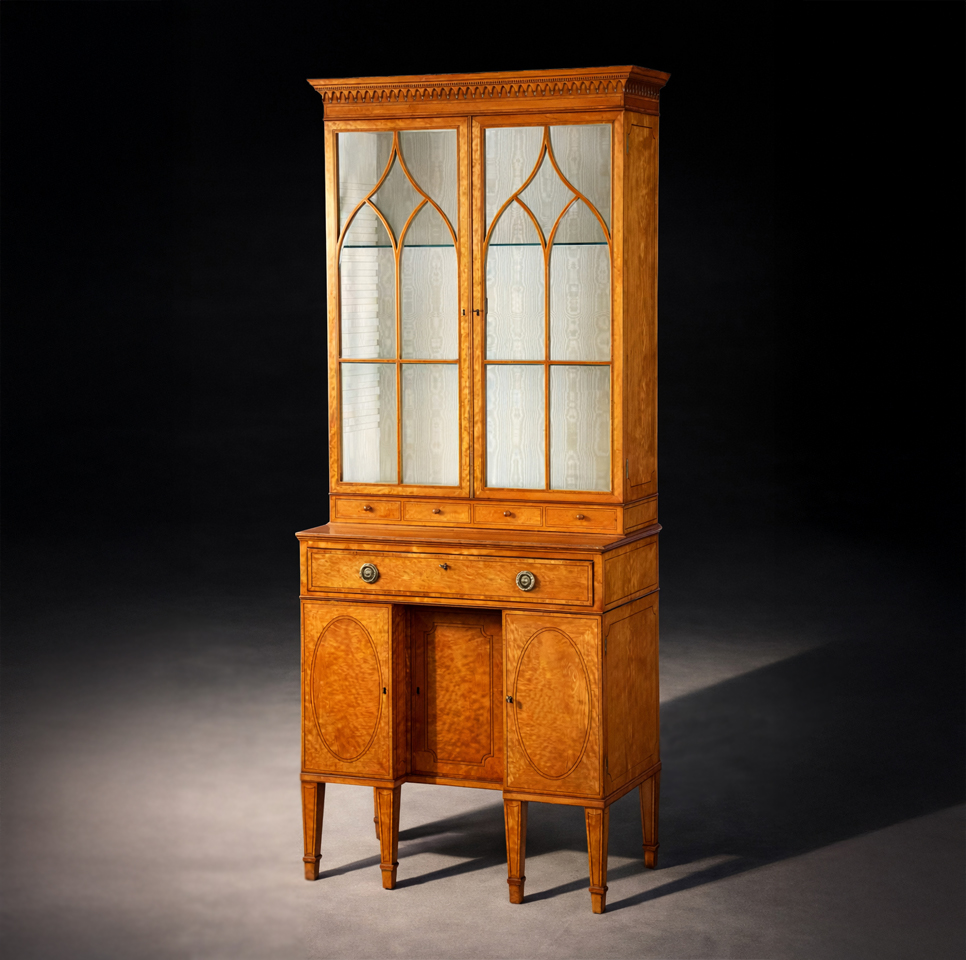
An Important George III Satinwood Secretaire Cabinet Attributed to Thomas Sheraton
Reference 1035
English, ca. 1790
This cabinet is conceived in two graceful sections. The upper portion features astragal-glazed doors enclosing three later-adjustable glass shelves, set above four finely proportioned short drawers.
Below, the lower section offers a single frieze drawer fitted with a baize-lined writing slide, surmounting three cupboard doors.
The flanking cupboards each enclose an internal shelf. The cabinet is raised on six square, tapering legs, lending a sense of lightness and architectural poise to the design.
Crafted from the finest East Indian satinwood, the cabinet displays exquisite figuring and a warm, golden lustre. At the time of its creation, satinwood of this calibre represented the very pinnacle of cabinetmaking, and this piece stands as a consummate expression of the form.
The design is exceptionally delicate and beautifully judged, with elegant proportions that speak of both refinement and confidence. It possesses a quiet authority, serious in its elegance, yet undeniably captivating.
Thomas Sheraton (1751–1806), of 163 Wardour Street, Soho, London, was an influential English cabinetmaker, designer, and writer whose ideas shaped late eighteenth-century furniture. Though few pieces can be firmly attributed to his workshop, Sheraton’s impact came through his pattern books, especially The Cabinet-Maker and Upholsterer’s Drawing-Book. He promoted refined Neoclassical forms, light proportions, straight lines, and elegant inlay, reflecting Enlightenment taste and urban sophistication. Sheraton emphasised technical accuracy, geometry, and moral improvement, believing good design elevated society. His published designs spread widely among craftsmen, defining the Sheraton style and leaving a lasting legacy in British and American furniture making during the Regency era and beyond.
Dimensions
Width 90cm (35.5″)
Height 208cm (82”)
Depth 47cm (18.5″)
Provenance
Jeremy Limited, London
Literature
Ralph Fastnedge, Sheraton Furniture, London, 1962, fig. 69
POA
+ 44 (0) 7880 620 291